


A Natural History of Towner's Woods
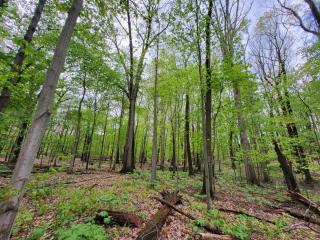
As we approach the 50th anniversary of our oldest Portage Park, Towner’s Woods, it is a time to recognize and appreciate the natural resources and deep natural history of the land and reflect on the changing use history that shaped it. Towner’s Woods boasts a very diverse mix of habitats, including some that are unique to our county and rare within our state. A walk through Towner’s Woods along its many trails gives one a first-hand look at this diversity. You are first taken through a beautiful old-growth oak forest upon low rolling hills of sand and gravel deposits that then transitions to much younger mixed forest and shrubby meadows. Eagle Trail covers the northern section of the park and returns to a more mature forest canopy and dry slopes. Scattered throughout these habitats lie numerous vernal pools and small bogs. As you head further east, the forest returns to a more, albeit somewhat younger, mixed oak forest over rolling hills that give way to a large bog that accents the easternmost boundary of the property, just in view from Wetlands Trail. South of The PORTAGE Hike and Bike Trail, Butterfly Trail offers a look at open meadows and shrub habitat, as well as a mixed emergent marsh.
All of these habitats are beautiful, beneficial, and to be appreciated. Much of what we experience and enjoy at Towner’s Woods now was quite different in the not-so-distant past. One of the best ways to gain an understanding of this is to examine the history of the land with historical aerial imagery. It helps us to discover the journey of changes in land use that have shaped and defined the wonderful habitats we now enjoy at Towner’s Woods and appreciate the values they bring to our county.
It is easy for me to start by looking at one of my own favorite habitats at Towner’s, the old-growth oak forest in the western end of the property. This area features large black, scarlet, red, and white oak trees exceeding 100 years of age. Flowering dogwoods and blueberry shrubs are dotted through the understory. What a true gem to have such an undisturbed stand of trees in our area. As I’ll discuss, so many parts of Towner’s Woods have endured many alterations, yet somehow, this site was spared and is incredibly special in the area. If we look at the aerial photography from 2025, this forest can seem to blend with nearby forests in the east side of Towner’s and those around Lake Rockwell to the west. Looking back to the images from 1937 (the oldest readily available), it is revealed that at that time, our magnificent old growth forest at Towner’s, as well as the Eagle Trail area, were the only mature forests to be found in the local landscape, appearing as full and lush as they do now. In those same images, large plantations of young, newly planted Norway maples cover most of the land around Lake Rockwell, revealing that the original forests in those areas had been eliminated. So the area surrounding the Hopewell mound is an exceptional snapshot of what our local forests once were. Aside from minor sand and gravel mining and the excavations at the mound, this forest has largely been left as intended and is a true gem to be cherished and conserved.
The central portion of Towner’s is quite a different story, with a mix of forest and shrubby meadows surrounding the mowed sledding area. The forested areas may appear to have some taller, larger trees, but the stands are composed of much different species than the old growth, like red maple and wild black cherry. For some it may come as a surprise, but much of this area was maintained as open pastures and fields as recently as 1985. It was around then that intensive mowing and grazing ceased altogether. This section represents an example of young forests commonly found throughout the county. Bogs and vernal pools within the area are benefitting from the newly established forest canopy and buffers that have developed over the last 40 years.
Moving east, the large wetlands also have a storied past. The large bog at the eastern boundary continues to thrive despite a history of being drained dating back to at least 1937. One can only wonder how it appeared prior, as by that year, the entire wetland appears as neatly rowed, drained fields, undoubtedly producing heavy harvests of crops and vegetables upon the rich peat and muck. It is not until 1970 to 1975 that, like many attempts to drain peatland, the efforts to keep the area friable proved futile, and the wetland began its recovery to again host a suite of bog plant species, some very rare, and includes a thriving stand of tamarack trees. From a first-hand account, I can say that this very special wetland is fraught with many dangers. Poison sumac is abundant. Peat and hummocks float atop underlying water in much of the area. One may feel they are navigating safely only to suddenly break through the floating layer and find themselves armpit deep into the hummocks and peat with legs flailing about in a seemingly bottomless mass of water. Most often, attempts to cling onto nearby vegetation usually result in grasping a healthy poison sumac stem directly, giving one an itchy rash reminding them for weeks that the area is best left viewed from afar! Such visits are reserved for necessary botanical and stewardship work by those authorized and experienced to do so.
Lastly, the Butterfly Trail area brings its own unique habitat features to the park. This section of land was also pastured and mowed into the mid 1980’s. It is, however, bound by two rail lines at the north and at the south. The north line is of course now the PORTAGE Hike and Bike Trail, and the line on the south is still active as the Wheeling and Lake Erie Railroad. This has had an influence on the plant community in around Butterfly Trail and the Hike and Bike. Both lines generally stretch east and west, resulting in some western species hitchhiking with the trains. Several western prairie species, such as big bluestem, switch grass, and spiderwort occur along the trail, and have led to the development of some smaller, prairie-type open areas. These small wonders act as a monument to the railroad history of the area and the large prairies in western Ohio.
We live on a landscape where virtually every single aspect of the natural world has been affected by human activity, often to the detriment of important parts of our natural heritage. As we celebrate the 50th anniversary of Towner’s Woods, we should also celebrate the amazing natural features and resources that it provides and protects. It is an excellent example that conservation works and that nature can and often does persevere despite a history of radical impacts.